
The ecommerce landscape just took a major leap forward. On January 11, 2026, Shopify unveiled its agentic commerce platform, a powerful new system built on the Universal Commerce Protocol (UCP), an open standard co-developed with Google and endorsed by more than 20 retailers and platforms.
This isn’t just another AI feature. It’s a deliberate strategy to make commerce native across major AI channels, turning conversational interfaces like Google AI Mode in Search, Gemini, Microsoft Copilot, and more into seamless shopping destinations. For merchants, developers, and brands, the implications are profound.
What Is Agentic Commerce and UCP?
Agentic commerce allows AI agents to discover products, handle personalized recommendations, manage complex checkout flows, and complete transactions on behalf of customers, all within natural conversations.
At the core is UCP, an open-source protocol that acts as a “universal language” between merchants and AI agents. It supports critical commerce elements that traditional AI integrations often struggle with:
- Discounts, loyalty programs, and subscription billing
- Delivery preferences and custom terms (e.g., “ship on Friday, not Thursday”)
- Bundling, pre-orders, and final-sale conditions
- Compatibility with any payment processor, including Shopify Payments
- Flexible transaction types: conversational, embedded checkouts, or web-based flows
UCP ensures merchants remain in control as the Merchant of Record, preserving business rules while enabling AI agents to deliver accurate, context-driven experiences.
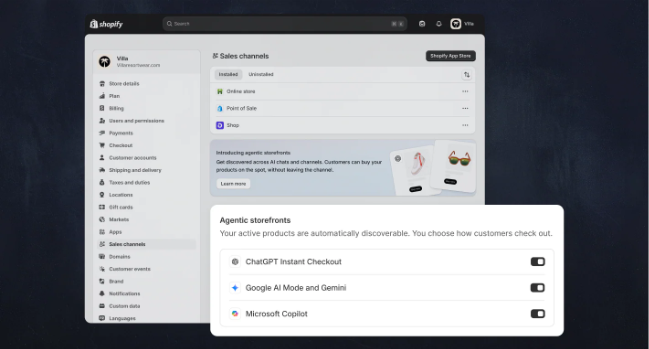
Shopify is also rolling out the Agentic plan, allowing non-Shopify brands to upload their catalogs and sell directly through AI channels without migrating to the platform. Meanwhile, Agentic Storefronts give merchants centralized management in Shopify Admin, and integrations are already live or coming soon with Google (AI Mode & Gemini), Microsoft Copilot (embedded checkout), and ChatGPT.
The Upside: A New Era of Frictionless, Personalized Shopping
For ecommerce businesses, the advantages are compelling:
- Reach customers where intent peaks — AI agents surface products in real-time conversations, delivering deals and recommendations exactly when shoppers are asking questions.
- Merit-based discovery — Products appear based on relevance and context rather than ad spend or SEO gaming, potentially leveling the playing field for niche and emerging brands.
- Reduced friction and higher conversion — Complex flows like subscriptions, bundling, and personalized delivery become effortless in chat, building customer habits and loyalty.
- Broader distribution without heavy lifting — Brands like Monos, Gymshark, Everlane, Keen, and Pura Vida are already participating in early integrations, reaching millions through AI surfaces.
This could accelerate online shopping in the same way mobile and COVID-era shifts did, only faster and more personalized.

The Potential Downsides: Adaptation, Adoption, and Disruption
No platform shift is without challenges:
- Gradual rollout — Most experts expect agentic commerce to start as an occasional channel before becoming dominant. Early experiences may not be flawless, and widespread adoption will take time.
- SEO and paid search disruption — If AI agents deliver unbiased, context-driven results, traditional search engine visibility and ad-driven discovery could lose relevance, forcing marketers to rethink strategies.
- New operational demands — Merchants will need clean, structured catalogs and ongoing merchandising efforts to stay competitive in AI feeds. Smaller teams may face a learning curve.
- Dependency on ecosystem buy-in — For agentic commerce to reach its full potential, a wide range of brands must participate. If adoption lags, selection could remain limited.
The Bottom Line for eCommerce Businesses
Shopify’s agentic commerce platform and UCP represent a foundational move toward a future where commerce flows naturally through every conversational interface, search, assistants, productivity tools, and beyond.
For forward-thinking brands, this is an opportunity to gain first-mover advantage, reach shoppers in high-intent moments, and build loyalty through delightful, frictionless experiences. For others, it’s a signal to prepare catalogs, monitor integrations, and adapt strategies as AI becomes a primary channel for discovery and purchase.
The race to agentic commerce has begun. Early participants will help define the rules, and the winners will be the brands that master this new shared language of commerce.
At i95Dev, we’re closely tracking this shift and helping clients position their catalogs and strategies for the agentic era. The future of ecommerce is conversational, open, and incredibly promising. Are you ready?