
- The Expectation Gap: What Buyers Want vs. What They Experience
- Where the Personalization Breakdown Really Happens
- The Real Cost of Getting Personalization Wrong
- How to Know If Your Digital Platform Is Failing Personalization
- How Leading B2B Organizations Are Solving the Personalization Challenge
- Why Personalization Requirements Differ Across B2B Industries
- The Path Forward
- Conclusion
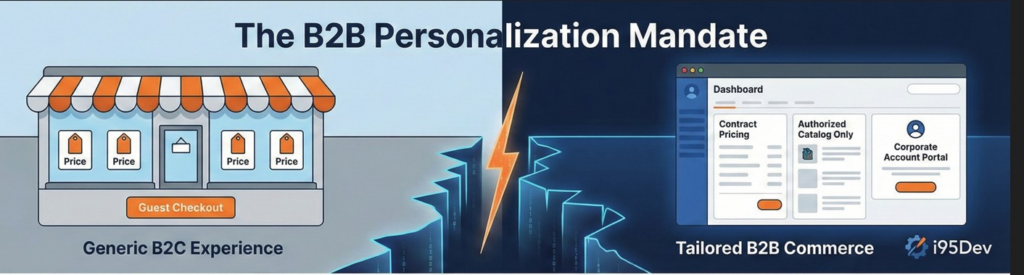
For years, B2B organizations have been racing to modernize their digital channels – launching new portals, migrating to modern commerce platforms, and investing heavily in ERP and system integrations. Yet despite these efforts, many B2B buyers still describe their online experience as feeling like a B2C website wearing a corporate badge: one-size-fits-all pricing, open catalogs, generic “sign up” forms, and no financial visibility beyond order history.
The problem isn’t that B2B companies don’t care about digital transformation. The problem is that most digital commerce platforms fail to reflect the complexity of real-world B2B relationships – relationships built on negotiated pricing, authorized product access, contractual commitments, account hierarchies, and long-term trust.
And that’s where the personalization mandate becomes unavoidable: B2B commerce must evolve from a generic storefront into a digital execution layer of business contracts, pricing rules, access control, and financial governance.
Because in B2B, personalization is not about marketing.
It is about operational truth.
When that execution fails, everything else breaks.
The Expectation Gap: What Buyers Want vs. What They Experience
B2B buyers expect digital channels to let them do everything they already do offline – but faster, more accurately, and without needing a sales rep to validate pricing or eligibility. They expect contract pricing they can rely on, access only to products they are allowed to buy, onboarding that reflects who they are, and a financial portal where they can see and pay invoices without waiting for email exchanges.
But what they often encounter is a storefront that treats them like strangers.
This disconnect is what quietly destroys digital adoption. When customers see the wrong price, the wrong product, or an incomplete financial picture, they stop trusting what the platform shows them and revert to manual ordering channels. The result is not just an inconvenience – it’s lost efficiency, frustrated buyers, internal friction, and ultimately lost business.
And until digital channels mirror the intelligence and nuance of offline commercial relationships, B2B digital transformation will continue to fall short of its promise.
Where the Personalization Breakdown Really Happens
If the need for personalization in B2B commerce is so clear, why do so many organizations still struggle to deliver it?
It’s common to blame platform limitations or integration challenges, but the deeper issue is architectural. Most commerce platforms were designed for consumer simplicity, not contract complexity. They assume uniform pricing, universal catalogs, and straightforward checkout flows—exactly the opposite of how B2B businesses operate.
ERPs, on the other hand, are built to manage that complexity: pricing matrices, discount groups, buying groups, brand restrictions, account codes, approval workflows. Yet when ERP and eCommerce interpret rules differently, the digital experience falls apart.
That misalignment leads to the symptoms customers feel every day: incorrect prices online, access to products they should never see, onboarding delays, and no financial visibility. Not because businesses don’t understand personalization, but because their systems weren’t built to execute it.
Until digital commerce is architected to honor the rules already living in the ERP, personalization will remain superficial rather than operational.
The Real Cost of Getting Personalization Wrong
When personalization breaks in B2B commerce, it is rarely noticed first inside IT or operations. It’s noticed by the customer, the moment something doesn’t align with what they know to be true.
- A buyer logs into the portal and sees a price that contradicts their negotiated agreement.
- A regional distributor sees premium products they’re prohibited from selling.
- A purchasing manager can’t access invoices or payment history and must call accounting for help.
Each of these moments sends the same message: the digital channel can’t be trusted.
And in B2B, trust is currency.
Once a buyer loses confidence in the portal, they revert to human channels – emails, phone calls, sales reps, spreadsheets – and the intended benefits of digital transformation disappear. What should be a frictionless, automated, scalable model collapses back into manual effort. Order accuracy declines, costs increase, and sales teams become order processors instead of business advisors.
Beyond operational inefficiency, the risk becomes commercial. Incorrect pricing can trigger disputes, credit adjustments, and margin erosion. Poor catalog governance can create channel conflict, damaging dealer ecosystems built over years. In industries governed by compliance or distribution territories, it can even become a legal or contractual liability.
A single unauthorized SKU can sour a channel relationship years in the making.
A single pricing discrepancy can jeopardize an enterprise account.
A single onboarding failure can send a customer back to a competitor.
So, while the failure may appear technical on the surface, the consequences are profoundly relational and financial. The cost is not the feature gap itself, it’s the erosion of loyalty, repeat business, and long-term revenue confidence.
The risk isn’t losing a cart checkout. It’s losing the customer relationship.
In B2B commerce, personalization isn’t a nice-to-have. It’s the backbone of digital trust.
Without trust, customers won’t use digital channels, and without adoption, transformation fails.
How to Know If Your Digital Platform Is Failing Personalization
The breakdown of personalization is not always obvious from the inside. Systems appear to be working, data is syncing, orders are flowing, and the platform reports look healthy. But the clearest indicators surface not in dashboards, but in customer behavior and feedback. When buyers repeatedly bypass the portal or question what they see online, the problem is already active.
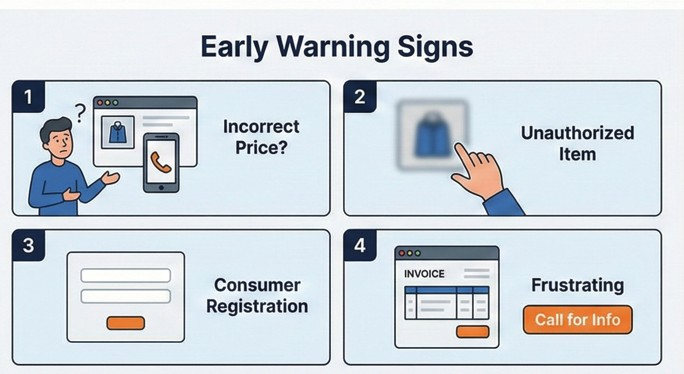
Here are some of the most telling signs, each rooted in real customer experience scenarios:
- One of your long-standing distributor accounts logs in and immediately calls their sales rep because the pricing online doesn’t match their contracted rates. They want to confirm whether the number on the screen is a mistake.
- Impact: This indicates a breakdown in contract-based pricing execution, and once customers stop trusting the accuracy of pricing in your portal, they stop using it for transactions altogether.
- A buyer from a protected region contacts support after seeing a premium product they shouldn’t have access to. They’re confused, and worse, a preferred dealer finds out and raises concerns with your channel management team.
- Impact: This is a failure of catalog governance and can escalate into channel conflict or contractual disputes.
- A corporate purchasing manager attempts to register online but finds only a basic, consumer-style form. It doesn’t recognize their account code, route for approval, or capture the structure of their organization. They abandon onboarding and message their sales representative instead.
- Impact: This signals weak onboarding flows that ignore account structures and validation logic.
- A finance controller asks your AR team for invoice copies, payment status, and outstanding balance information because none of it exists in the digital portal.
- Impact: This reflects the absence of financial self-service, which eliminates one of the primary operational benefits of B2B eCommerce.
Or the simplest and most important sign of all – your customers keep placing orders through email and phone even though your portal is available.
When your digital channel becomes a reference tool instead of a transaction channel, personalization has failed.
These symptoms are not feature requests. They are signals that customers do not trust what they see online. And without trust, digital adoption stagnates, operational efficiency stalls, and the expected ROI from transformation dissolves.
How Leading B2B Organizations Are Solving the Personalization Challenge
For organizations that have successfully transformed their digital channels into trusted, contract-aware experiences, the turning point came when they stopped treating eCommerce as a standalone storefront and leveraged information they already had in their systems effectively. Instead of forcing complex B2B rules into a simplified retail structure, they redesigned the digital experience to reflect the operational truth of how they already do business offline.
This transformation is possible only when ERP intelligence, customer logic, and eCommerce experience are orchestrated together.
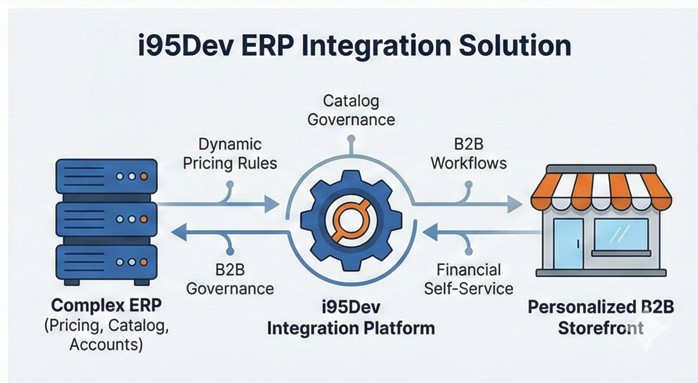
That’s where i95Dev specializes: aligning digital storefront behavior with real contractual rules. In partnerships with organizations like AirGlobal, Fechheimer, EarthCore Industries, Trimax Mowers, and others, we help teams build digital experiences customers trust, because they reflect the reality of business.
Challenge 1: Incorporating Complex B2B Pricing
- Context – B2B organizations often rely on multi-layered ERP pricing logic – contract-based discounts, pricing journals, customer/item combinations, rule priorities, and incremental adjustments. Generic tier-pricing can’t reflect this complexity.
- Solution – i95Dev interprets and orchestrates ERP pricing logic across every layer—discount groups, pricing agreements, item codes, increments, and priority rules. By transforming ERP pricing structures into personalized, account-based storefront pricing, we ensure each B2B buyer sees accurate, real-time contract pricing without manual overrides. Automated validation checkpoints prevent mismatched or outdated prices from ever reaching the storefront.
- Impact – Businesses eliminate pricing disputes, reduce manual quote corrections, and build trust by displaying accurate contract pricing for every customer. Buyers gain a reliable digital channel that reflects their negotiated terms, resulting in higher order volume and platform adoption.
- Case Study – Take AirGlobal, for example. Their buyers relied on complex trade agreement pricing structures in Dynamics ERP system, involving layered discount and priority rules that their eCommerce platform did not support. By extending their Magento/ Adobe Commerce store to incorporate this logic and presenting accurate, contract-specific pricing to each buyer, AirGlobal eliminated price discrepancies and restored trust. Orders increasingly shifted online because customers could finally rely on what they saw.
Challenge 2: Managing Catalog Visibility
- Context – Many B2B organizations must restrict product visibility based on authorized brands, customer levels, buying groups, or regional contracts. Standard eCommerce platforms lack the logic to enforce these constraints.
- Solution – i95Dev builds catalog governance layers that replicate ERP controls inside the storefront. Attributes such as allowed brands, product families, or buying group rules are synced and applied dynamically – filtering categories, hiding restricted SKUs, and shaping the storefront experience in real time.
- Impact – Channel conflict is eliminated, contractual obligations are protected, and customers only view products they are authorized to purchase. This creates cleaner navigation, reduces ordering errors, and aligns digital access with offline agreements.
- Case Study – Fechheimer faced a different challenge – product access. Their business demanded rigorous control over which brands and items different customer groups could purchase. By integrating catalog governance rules directly from the ERP into the storefront experience, they ensured buyers only saw the products they were authorized to buy. The result was reduced channel conflict and a more streamlined, intuitive purchasing journey. Earthcore Industries needed something similar. They were able to maintain channel integrity by tailoring product visibility to different buying groups.
Challenge 3: Customer Onboarding
- Context – Unlike B2C, B2B onboarding requires business verification, ERP account matching, approval workflows, and customer-type routing. A single “create account” form cannot support this complexity.
- Solution – i95Dev designs intelligent B2B registration flows with company-type routing (e.g., dealer vs. end customer), ERP account validation, and automated or manual approval processes. New account codes are generated when needed, while existing customers can link their ERP accounts seamlessly.
- Impact – Onboarding becomes efficient, predictable, and aligned with ERP customer structures. Sales and support teams spend significantly less time manually vetting registrations, and customers experience a professional, enterprise-grade process.
- Case Study – Similarly, Trimax Mowers transformed onboarding with an intelligent registration system that verifies account codes, routes approvals, and connects to ERP accounts.
Across these examples, the common outcome is clear:
trust increased, digital adoption accelerated, and operational efficiency improved – not because new features were added, but because the platform finally reflected the business relationship it was built to support.
The lesson is simple: when B2B personalization becomes operational, not cosmetic, digital commerce becomes a growth engine instead of a transactional website.
Why Personalization Requirements Differ Across B2B Industries
While the core principle of B2B personalization is universal – aligning digital experience with real contractual relationships – the way this requirement manifests varies significantly across industries. Each vertical operates under unique commercial models, distribution structures, and governance expectations, which shape what “personalized” must mean in practice.
- Manufacturing: Manufacturers rely heavily on controlled dealer and distributor networks where product access and territory protection are critical. Personalization here is about enforcing authorization rules with precision, ensuring specific customers can only view and purchase the products, brands, and configurations they are contractually entitled to. Any deviation risks channel conflict and long-term relationship damage.
- Distribution & Wholesale: Distributors operate under highly complex pricing and discount structures tied to volume commitments, product families, customer groups, and negotiated terms. For them, personalization lives primarily in pricing accuracy: digitally executing layered ERP pricing logic in real time. When pricing fails, margins disappear, making personalization a financial safeguard rather than a customer experience enhancement.
- Retail & Specialty Retail with B2B Buyers: Retailers that support both consumer and wholesale buyers require dual digital models within one platform. Personalization means clear segmentation: consumer storefronts optimized for browsing and marketing, and B2B portals driven by contract pricing, minimum order rules, and portal-only catalogs. The risk here is confusion – if wholesale buyers see consumer pricing or irrelevant product sets, the portal loses credibility immediately.
- B2B Services, Training & Compliance Organizations: For service-led businesses, personalization centers on onboarding and account controls rather than catalog or pricing. Approval flows, account hierarchies, entitlement rules, subscription lifecycle controls, and financial self-service capabilities determine whether customers can engage efficiently. If onboarding breaks, revenue stalls.
Despite these differences, the strategic takeaway is the same:
Personalization is not a single feature. It is the digital execution of each industry’s commercial model.
Organizations that understand this distinction architect their digital platforms to respect their business logic rather than working around it, and that’s where true competitive advantage emerges.
The Path Forward
B2B eCommerce was never meant to be a storefront. It is a relationship platform – a space where trust, pricing, access, and accountability all converge. The companies gaining real ROI from digital commerce are the ones who begin not with features, but with fidelity to the customer relationship.
If your eCommerce store adoption is poor, your platform isn’t broken. It’s simply not personalized.
Delivering true personalization in B2B commerce requires rethinking the foundational architecture that links ERP, eCommerce, and customer-facing digital experiences. This requires a shift to a model where the ERP acts as the authoritative brain and the commerce platform becomes the execution layer.
- ERP remains the single source of truth for pricing, customer attributes, financial data, and product governance.
- eCommerce is re-architected as a real-time interpreter, orchestrating ERP rules instead of duplicating or approximating them.
- Data flows become bi-directional and intelligence-driven, rather than nightly batch uploads or manual updates.
- Personalization is applied dynamically, based on the attributes and logic already defined in the ERP, not recreated manually.
- Governance replaces customization, reducing dependency on fragile workarounds that accumulate over time.
The outcome is more than a smoother experience. It is a platform where customers confidently rely on digital because it behaves exactly like the business relationship they already know.
The true value of personalization is not in convenience. It is in strengthening the commercial relationship.
Trust drives adoption. Adoption drives efficiency. Efficiency drives scalable growth.
Conclusion
Personalization in B2B is no longer a competitive differentiator. It is a commercial requirement. Without it, digital channels fail to earn trust, and without trust, they fail to drive adoption or revenue.
At i95Dev, we help organizations bridge the gap between ERP, business rules, and digital experience to make personalization real, not theoretical. Our role is part engineering, part workflow strategy, and part commercial alignment – ensuring technology reflects the truth of how the organization operates.
Ready to turn your digital channel into a true B2B relationship platform?
Talk to i95Dev’s B2B transformation experts today.