
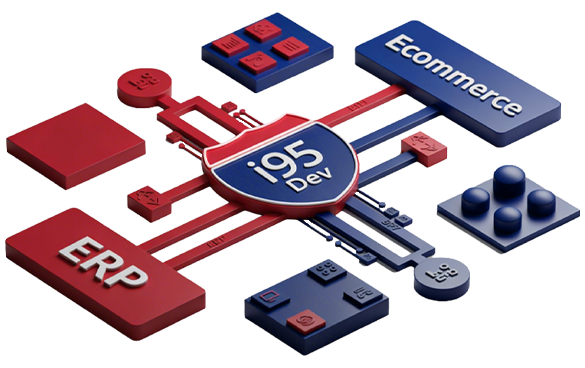


Patterns observed across real integrations
Most integration projects focus on connectivity: APIs, middleware, data flows.
But once systems are technically connected, a harder question emerges:
Do they interpret the business the same way?
ERP models operational truth.
eCommerce models buying intent.
When those models diverge, complexity surfaces — in pricing, tax, inventory, and order behavior.
Integration is not about moving data.
It is about aligning interpretations.
The Complete Reading List
Each blog in this series surfaces a different layer where ERP and eCommerce interpret the same data differently — and what it costs when that gap goes untranslated.
Your ERP sync can run without a single error and still quietly sabotage your storefront. The damage isn’t in broken jobs — it’s in operational logic reaching customers who were never meant to see it.
A catalog that looks perfect can still create revenue loss and fulfillment surprises the moment orders start flowing. Variants, units of measure, and bundles each carry hidden behavioral risk.
Tax can calculate correctly in both systems and still cause reconciliation chaos. A $1.02 difference is enough to break your entire close process — and it has nothing to do with either system being wrong.
Wholesale buyers seeing the wrong price, expired promotions still live online, cart totals that don’t match ERP — none of this is a sync failure. It’s a translation failure, and it affects customer trust directly.
Syncing raw ERP inventory to the storefront shows operational numbers, not customer commitments. The difference between what exists and what can be sold breaks trust faster than any error message.
Recognise any of this in your integration?
Most teams do- by blog three or four. The alignment audit maps your specific ERP and eCommerce stack against the translation failures this series covers, so you know exactly where your gaps are before they cost you.
Discount values can sync perfectly and still break your promotions. Explores how ERP discount logic — conditional, time-bound, and customer-aware — differs from how eCommerce platforms display and apply promotions.
Your checkout can show the right payment terms and still let the wrong orders through. When ERP financial controls don’t carry into the storefront, credit limits become suggestions — and finance cleans up what checkout confirmed.
“Real-time” is the most common promise in integration — and the most quietly broken one. When sync runs in near-real-time but your operations assume instant, oversells, stale prices, and conflicted orders become structurally inevitable.
ERP and eCommerce treat customer data with fundamentally different instincts. One overwrites for accuracy, the other appends for history. When integration does not translate the intent behind a customer record update, ghost data accumulates silently until it brings checkout to its knees. This blog explores the identity layer failure that makes every other translation failure worse.
Order edits can break ERP–eCommerce integrations by causing data mismatches across systems. i95Dev helps businesses manage real-time order changes without disrupting operations.
Returns expose the hidden gaps between ERP and eCommerce systems. This blog explains why return workflows often break integrations across finance, inventory, and customer experience.
ERP and eCommerce order statuses align for simple orders—but break apart when shipments split. This blog uncovers the communication gap between warehouse updates and customer expectations.
When ERP retires a product in stages and ecommerce only knows on or off, customers hit dead ends. Learn how lifecycle-aware ERP ecommerce integration fixes discontinued product sync for Shopify, Magento & BigCommerce.
ERP approval workflows can create delays and friction during B2B checkout, leading to abandoned carts and slower order processing. Learn the common causes and how to streamline approvals for a better buying experience.
Translation failures don’t announce themselves. They show up as revenue leakage, and customers who don’t come back. The audit finds them before your customers do.