ERP systems

Microsoft Dynamics 365

Business Central

AX Connect

NAV Connect

GP Connect

NetSuite / Oracle

SAP Business One

Sage 100

QuickBooks Enterprise
i95Dev
Connect
eCommerce + Marketplaces

Adobe Commerce

Magento

Shopify

Shopify Plus

BigCommerce

Salesforce Commerce Cloud

Amazon

eBay
“Choose the wrong approach once.
Spend the next five years fixing it.”
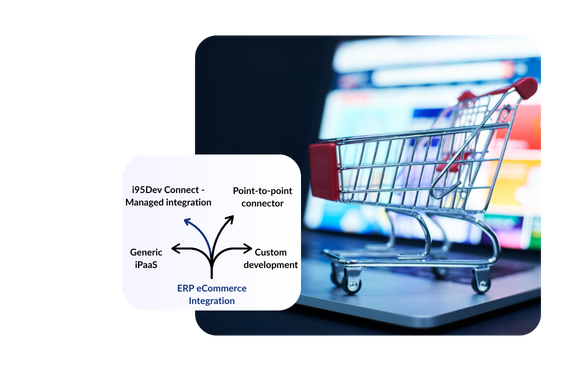
The two ERP eCommerce integration approaches mid-market teams most often choose between are generic iPaaS and managed integration. If you want the detailed comparison — how the two stack up on B2B workflows, update resilience, and total cost — that’s on the next page.
| EVALUATION AREA | CUSTOM DEV | POINT-TO-POINT | GENERIC IPAAS | I95DEV CONNECT |
|---|---|---|---|---|
| Who does the work | Your engineering team | Your engineering team | Your integration engineer | i95Dev — fully managed |
| API-based ERP eCommerce integration | Yes — you build it | Yes — pre-built connector | Yes — you configure it | Yes — prebuilt and maintained |
| Non-standard ERP configurations | Possible, high effort | Limited | Manual mapping required | ERP-native logic, 20+ years depth |
| B2B eCommerce ERP integration | Custom code required | Not supported | Custom development | Prebuilt B2B workflow library |
| High-SKU, multi-warehouse, contract pricing | Custom build required | Not supported | Custom development per rule | Native — configured, not coded |
| Platform update compatibility | Your team patches | Your team patches | Your team patches | Managed by i95Dev |
| Time to go-live | 3–9 months | 1–3 weeks | 3–6 months | 2–4 weeks |
| Internal engineer required | Yes | Yes | Yes | No |
| Year two maintenance burden | High | Medium-High | High | Managed |
| Right for | You have a unique ERP setup. You have an engineer to build and own it. | You’re early stage. One channel. Under 500 orders a month. | You want full control. You have an engineer who can own it. | You run ERP-connected commerce. You want the vendor to own the outcome. |
Most eCommerce website integration with ERP is built for clean, standard configurations — the kind that match the documentation. Most mid-market businesses don’t have those. They have a decade of customisation: modified approval logic, pricing tiers in custom tables, order routing rules only the original implementation partner fully understood.
The most common ERP eCommerce integration configuration we work with is Business Central or Dynamics 365 connected to Shopify or Adobe Commerce, with B2B pricing rules and multi-warehouse logic the eCommerce platform has no native awareness of.
Custom vs pre-built ERP integration is not just a build-or-buy decision. It’s a question of who carries the ongoing cost of keeping a custom build working as both platforms evolve.
Supported Platforms
What standard approaches handle well
- Standard ERP with clean, documented API configurations
- Straightforward field mapping across well-known objects
- Multi-department scope where commerce isn’t the focus
Where i95Dev Connect Goes Further
- ERP configurations modified over years, not months
- Native B2B eCommerce ERP integration: credit limits, tiered pricing, approval workflows — prebuilt, not custom-coded
- High-SKU catalogues with complex product data sync
- International payment terms and contract pricing per account
- Multi-warehouse and multi-distribution-centre routing
- Edge cases that only appear three months into a live integration
- 20+ years of Dynamics, NetSuite, and SAP B1 configuration depth
What accumulates with custom and iPaaS approaches
What’s fixed with managed integration
Estimate your savings (from manual effort) and payback period in minutes.
Estimated Results
Annual Labor Cost Saved: $0.00
ROI %: 0.00%
Payback Period: 0.0 months
This is your saving only in manual effort. There are other benefits that you can realize by automating eCommerce and ERP integration.
- Reduced Errors,
- Improved Customer Retention,
- Reduced Customer Service Calls,
- Improved Customer Experience,
- and more.
“Every day without it, your team is the integration.”
Every other ERP eCommerce integration method — custom development, point-to-point, iPaaS — puts the ongoing responsibility with your team. You own the configuration, the maintenance, the update cycles, and the 2am incident when something breaks before a product launch.
Managed integration works differently. i95Dev Connect is delivered and maintained by a team that already knows your ERP’s data model before the project starts. Implementation, configuration, monitoring, and incident response stay with us. Standard configurations go live in 2–4 weeks. Your team manages the business relationship — not the technical infrastructure.
Every project gets a dedicated project manager. The same team that configures the integration monitors it — and picks up the phone when something needs attention post go-live.
“We met on a weekly basis and the communication with i95Dev was exceptional. Everything was documented for us.“
Lou Bemer, Director of Technology, Contractor Nation
“Throughout the entire project lifecycle, they provided excellent project management and communication.“
Steve Gatton, Vice President of Information Technology, Fechheimer
For teams that want a single partner across integration, store development, and growth — that structure exists within i95Dev. Most customers start with the integration.
The concern we hear most: will live orders be disrupted during the switch? The answer is no. Here’s exactly how the transition works.
“The team at I95Dev did an outstanding job after go-live by supporting transaction monitoring, ensuring that our orders flowed through the system as designed.“
Steve Gatton, Vice President of Information Technology, Fechheimer
Timelines vary by ERP configuration complexity. Standard configurations move from audit to go-live in 2–4 weeks. The discovery step is where the timeline is confirmed.
Audit
We review your current integration — what it does, what it misses, what breaks, and how often. Includes ERP configuration mapping and review of any custom logic built on top of the standard setup.
Discovery
We produce a detailed requirements document. Every workflow, every data object, every business rule — documented before a single line of configuration is written. Your team signs off before we proceed.
Configure and Customise
i95Dev Connect is configured to your requirements in a development environment. Your existing integration continues running in production, untouched. Nothing changes for live orders at this stage.
Validate
The configured integration is tested against your ERP data in the development environment. Your team validates that every workflow — orders, inventory, pricing, B2B logic — behaves exactly as specified.
Production
Once your team signs off on validation, your existing integration is stopped. i95Dev Connect moves to production. This is the only moment of switchover — planned, controlled, and agreed in advance.
Test and go-live
Final production testing with live data. Your team signs off. i95Dev monitors the first weeks of live operations closely — the same team that configured the integration is watching it run.
The right ERP integration for eCommerce doesn’t just move data. It removes the work your team was doing to compensate for data that wasn’t moving. The clearest signal that B2B eCommerce ERP integration is working is that the team stops getting pulled into inventory discrepancy checks, order exceptions, and late-night reconciliation. Earthcore Industries redirected roughly a third of their operations team’s weekly hours toward work that compounds.
It has simplified our order taking from our website to GP. The connector is very stable. Our entire customer service team is very happy with it. It made their life much easier.
Siegers Seed Company
The i95Dev team was extremely helpful in getting our integration with Dynamics GP set up with our new website platform. We’ve worked with other partners in the past with the same integrations and it was much smoother with the i95Dev team.
Theresa Kuske, Digital Marketing Director, Ergodyne
I am very impressed with i95Dev — the project was quite complicated and i95Dev’s team worked diligently to provide reasonable solutions for everything that came up. In the end, we are confident that we chose the right partner for this project.
Justin Gonsalves, Accounting Supervisor, ALPCO
Generic iPaaS is probably right if
Managed integration is probably right if
Most teams find the answer becomes clear once they’ve mapped their ERP configuration and internal capacity against these criteria. The integration assessment helps with that.
Get Clarity on Your ERP Integration Strategy
Most teams find the answer becomes clear once they’ve mapped their ERP configuration and internal capacity against these criteria. The integration assessment helps with that.

Before a mid-market IT Director signs off on any integration that touches ERP data, customer credit limits, and order history, they need to know the answer to a question they sometimes feel awkward asking directly: who has access to our data, and what happens to it?
We operate as a data processor. Your ERP and eCommerce data passes through the integration layer to synchronise between your systems — we don’t store, sell, or use it for anything else. Access is controlled, logged, and auditable. When an engagement ends, data access is revoked.
For enterprise procurement — we can provide a data processing agreement (DPA) and respond to security questionnaires. Raise it in the integration assessment.

Parner Network

Partner Network

Partner Network