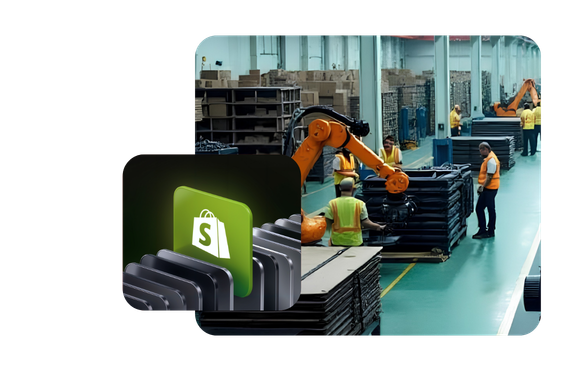
Shopify Plus, Built for Manufacturing Complexity
Not every manufacturer is ready for Shopify Plus — and not every Shopify Plus partner understands manufacturing. i95Dev sits at that intersection: deep ERP expertise, B2B commerce architecture, and 200+ integrations delivered.

Partner
Shopify Plus Certified
18+ Years
in B2B Commerce
200+
ERP Integrations Delivered
ERP Sync Accuracy
real-time inventory + pricing sync uptime
B2B + DTC on One Platform , SAP · Epicor · NetSuite · Dynamics 365
The Operational Complexity Shopify Plus Handles
Manufacturing commerce isn’t complicated because of volume — it’s complicated because of layered rules, relationships, and legacy systems that have to work in concert.
B2B and DTC Coexisting Safely
Running wholesale and direct-to-consumer without channel conflict means territory rules, product segmentation, and pricing visibility controls that have to be architectural — not patched in later.
Thousands of SKUs with Variant Matrices
Configurable products, BOMs, accessory dependencies, and restricted SKUs visible only to certain account types require structured catalog architecture, not ad-hoc product management.
Multi-Tier Pricing & Contract Logic
Account-specific contract prices, volume tier breaks, dealer-protected minimums, and promotional overrides that vary by customer segment — all needing to resolve in real time at checkout.
ERP as the Source of Truth
Customer accounts, credit limits, inventory levels, and contract prices all live in your ERP. Every order placed in Shopify has to push back — and every ERP update has to surface immediately.
EDI, PO Workflows & RMA Management
B2B buyers expect purchase order support, net payment terms, and structured returns with ERP-pushed RMA numbers — not the guest-checkout experience of a consumer store.
Multi-User Buying & Approval Chains
Large accounts order through several buyers with different spending limits and sign-off requirements — approval routing and role-based purchasing permissions that generic B2B storefronts don’t support natively.
Most Shopify agencies can’t navigate this complexity.
i95Dev builds the ERP integration layer, the pricing engine, and the B2B portal — not just the storefront.
How Manufacturers Use Shopify Plus
The same platform, deployed across very different manufacturing scenarios — because the underlying architecture is flexible enough to meet you where you are.
Replace Offline B2B Ordering
Migrate dealer and distributor order-taking from phone, email, and EDI into a branded self-service portal — with account pricing, PO workflows, and real-time stock visibility already connected to your ERP.
Launch Direct-to-Consumer Without Disrupting Dealers
Open a consumer storefront on the same catalog and inventory as your B2B portal — with channel-safe pricing, territory restrictions, and dealer-protected SKUs enforced at the platform level.
Replace Legacy or Fragmented Platforms
Consolidate multiple storefronts, spreadsheet-based ordering, or aging Magento/custom builds onto a single Shopify Plus platform — reducing catalog duplication, split inventory, and double operations overhead.
Make Your ERP Commerce-Ready
Turn your ERP into a live commerce engine — surfacing real-time pricing, contract terms, stock levels, and customer accounts directly into the Shopify storefront without manual data entry or batch sync delays.
Give Sales Reps a Digital Tool
Deploy a rep-assisted ordering interface where your sales team can place orders on behalf of accounts, view ERP pricing, check live inventory, and track order status — reducing errors and order cycle time.
Expand to New Markets & Channels
Use Shopify Plus’s multi-storefront and multi-currency infrastructure to enter new geographies or market segments — with localized pricing, tax rules, and language support managed from one back end.
What Manufacturers Need to Know About ERP Integration
ERP integration is not a feature — it’s the infrastructure. Getting it right determines whether your commerce platform runs smoothly or creates more operational drag than it solves.
ERPs We Integrate With
Not seeing your ERP? We’ve integrated 200+ systems. Ask Us.

Why Shopify Plus Wins for Manufacturing Commerce
Compared to legacy enterprise platforms, Shopify Plus delivers more manufacturing-specific capability at a fraction of the total cost of ownership — when implemented by the right partner.
Legacy Enterprise Platforms
Shopify Plus — with i95Dev
Frequently Asked Questions
Is Shopify good for manufacturing companies?
Yes. Shopify, especially Shopify Plus, is now adopted by more manufacturers looking for a cutting-edge and scalable ecommerce platform capable of supporting both business-to-business and business-to-consumer sales. It comes with inbuilt B2B capabilities, such as company profiles, personalized prices, net terms, and purchase orders, while offering a world-class storefront that manufacturers can build and improve easily.
Can Shopify handle B2B and DTC selling for a manufacturer on the same platform?
Yes. Shopify Plus allows manufacturers to operate a B2B wholesale portal and a direct-to-consumer storefront from the same Shopify admin. Each channel has its own pricing, product visibility and order workflows but uses the same product data and backend management. This removes the need for two separate platforms and greatly reduces integration complexity.
How does Shopify integrate with manufacturing ERP systems?
Shopify has certified connectors that work with leading manufacturing ERP platforms, including SAP Business One, Microsoft Dynamics 365 Business Central, Dynamics 365 Finance & Operations, NetSuite and Sage. i95Dev Connect is a managed integration to sync products, inventory, pricing, customer accounts, orders and shipment tracking between Shopify and your ERP in real time. No more manual data entry and no more mistakes in either system.
What Shopify B2B features are available for manufacturers?
Shopify’s built-in B2B features for manufacturers include: Company accounts with multiple buyers and permission levels Customer-specific price lists Net payment terms (Net 30, Net 60) Purchase order payment methods Volume pricing Draft orders Self-service buyer portal where dealers can browse, order and manage their accounts All these features are built-in with Shopify Plus and don’t need to use any third-party apps.
How long does it take to implement Shopify for a manufacturing business?
A typical Shopify implementation for a manufacturer takes 8-14 weeks depending on ERP integration, product catalog complexity and B2B requirements. Filtrous, a B2B laboratory supply manufacturer, built their Shopify wholesale channel in 63 days. Today, the global manufacturing company Carrier builds new Shopify storefronts in about 30 days. i95Dev provides phased implementations, allowing manufacturers to go live with core commerce and then add ERP integration and advanced B2B features in subsequent phases.
Can Shopify handle dealer and distributor portals for manufacturers?
Yeah. Dealers and distributors can login to dedicated B2B buyer portals to view their account-specific pricing, place bulk orders, reorder from order history, manage multiple buyers within their company account and track order status all without calling on your sales team. i95Dev’s B2B portal solution includes ERP-connected pricing, credit limit enforcement and approval workflows that map to your existing dealer management processes.
Does Shopify support purchase orders and net payment terms for B2B manufacturers?
Yes. Dealer and distributor users have access to specialized B2B buyer portals where they can check the price of their account, place bulk orders, place reorder based on order history, manage various buyers under their account and even monitor the order status without bothering your sales team. The B2B portal solution by i95Dev has ERP connected pricing, credit limit check and workflows that are aligned to your dealer management process.
How does i95Dev help manufacturing companies implement Shopify?
i95Dev is a certified Shopify Plus partner specialising in manufacturing commerce. We design and implement Shopify stores with full ERP integration, B2B dealer portals, multi-storefront configurations, and custom workflows suited to manufacturing operations. Our i95Dev Connect platform handles real-time data synchronisation between Shopify and your ERP — including SAP, Dynamics 365, NetSuite, and others — and our team provides ongoing managed support after launch.
What is the difference between Shopify Plus and standard Shopify for manufacturers?
The standard Shopify packages today come with basic B2B functionalities, while Shopify Plus is specifically built for those manufacturers who require sophisticated B2B functionalities such as company accounts with hierarchy of buyers, B2B dedicated storefronts (B2B on Shopify), custom checkout scripting, increased API rate limits for integration of an ERP system, dedicated merchant success management, and exclusive Shopify Plus applications.
Can Shopify handle large product catalogs for manufacturers?
Yes. Shopify Plus is capable of handling product catalogs of sizes where the number of SKUs runs into hundreds of thousands. Such product catalogs come with various attributes of the product, including part numbers, technical data, variants, and configurable products. With the help of i95Dev Connect to your ERP or PIM system, automatic synchronization of product updates can be done on Shopify.
How does Shopify handle customer-specific pricing for B2B manufacturers?
In Shopify, the prices will be listed in price lists for individual companies or specific customer groups. Every dealer gets logged in to view their own set of contractual prices and does not see the usual retail prices you get from other places. If Shopify is integrated with your ERP, then the contractual dealer prices from ERP contracts are synced into Shopify price lists.
What is the ROI of implementing Shopify for a manufacturing business?
The manufacturers that have been using Shopify Plus have experienced considerable benefits in their operations. For instance, Snyder Performance Engineering has experienced a 25% improvement in the amount of time spent on back office tasks and a 40% increase in the average purchase amount per client. At the same time, Industry West has seen a 90% increase in the proportion of B2B revenue and 20% higher average order value. In turn, Mac Tools managed to increase its orders by 25% when it started using Shopify Plus.
Is Shopify better than BigCommerce for manufacturers?
Both platforms have their strengths, and the choice will depend on what you value. Shopify Plus has the edge when it comes to ease of use, robustness of the apps ecosystem, direct-to-consumer selling expertise, and time to deploy. On the other hand, BigCommerce B2B Edition is richer in native B2B functionality — especially the corporate hierarchy accounts and quotation features. Manufacturers looking for a contemporary shopping experience, fast time to market, and rich ecosystem of partners usually go for Shopify Plus, while those requiring native B2B processes without customization opt for BigCommerce. i95Dev implements both platforms and can help you choose the right one for you.
Ready to Build the Manufacturing Commerce Platform Your Business Needs?
Talk to an i95Dev manufacturing commerce specialist — get a tailored scope, timeline, and ERP integration roadmap.
Discover:
