


BigCommerce and Shopify are major players in the world of hosted eCommerce software platforms. BigCommerce and Shopify are website builders that allow you to sell products online, whether digital or physical. There is no denying that BigCommerce and Shopify both have earned their places at the top of the eCommerce platform landscape.
Both platforms are aimed at people who are starting a new online selling business venture without an extensive budget for web development. They allow you to manage your eCommerce store from anywhere, as both products run in a web browser.
But choosing either of them as a beginner can be tricky. Let i95Dev’s comparison between the two help you choose the best eCommerce software solution for your online shop. By the end of this comparison, you should know which of these two products can be the best eCommerce platform for your business.
Pros and Cons of Shopify vs BigCommerce
| BigCommerce Pros | Shopify Pros |
| No transaction fees on any plan | Bigger app store with multiple tools to address common issues |
| Has an incredible amount of built-in sales features, with no need for installations | Vivid theme options to reduce the customization workload on your part |
| Can accommodate upto 600 variations per product | Website management is simple with Shopify’s easy-to-navigate dashboard |
| BigCommerce Cons | Shopify Cons |
| Not a lot of variations between different store themes | Transaction fees apply unless using Shopify Payments |
| A small learning curve is required for advanced features | Poor for international scalability – rely on third-party apps for multi-currency support |
| Features options aren’t as customizable as Shopify’s | Switching templates translates to reformatting your sites |
Which Has Better Pricing
One of the first questions that potential BigCommerce and Shopify users ask is – “How much do they cost?” Let’s take a look at that:
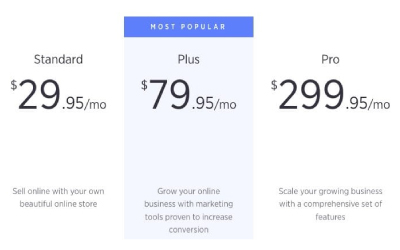
Both BigCommerce and Shopify offer three pricing plans. BigCommerce’s plans range from $29.95/month to $299.95/month. Shopify’s plans range from $29/month to $299/month. Both platforms offer discounts up to 10% if you pay annually instead of monthly.
BigCommerce Pricing
Shopify Pricing
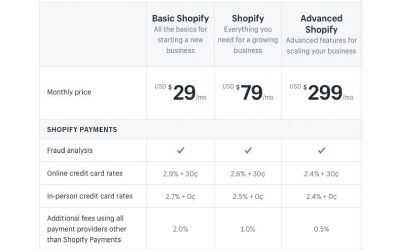
BigCommerce offers a free trial for 15 days, while Shopify provides it for 14 days. Both platforms don’t have much price difference, but it’s all about what tools and features you actually get for the price you pay.
BigCommerce depends less on third-party apps than Shopify, which means more tools come included in the cost of your BigCommerce store. Shopify allows you to drag and drop elements onto your homepage, but to get similar flexibility across all pages, additional apps may be required.
Pricing Verdict: Shopify vs BigCommerce
BigCommerce offers more value for money due to its strong set of built-in tools and lack of transaction fees.
Ease of Use Comparison
Users usually find Shopify easier to use than BigCommerce. Shopify allows products to be added through a simple form and provides helpful guidance along the way.
BigCommerce offers powerful features but may require a slightly steeper learning curve. However, its drag-and-drop page builder offers strong design flexibility.
Ease of Use Verdict
Shopify is easier for beginners, while BigCommerce offers more advanced functionality for experienced users.
Sales Features Comparison
Both Shopify and BigCommerce provide essential eCommerce features such as:
SSL Certificate – Protects customer data and ensures secure transactions.
Basic Shipping Tools – Allows configuration of shipping rates and locations.
Multichannel Selling – Enables selling across platforms such as Instagram, Facebook, and Pinterest.
BigCommerce: Built-In Feature Advantage
BigCommerce includes many features directly within the platform, reducing the need for third-party apps. These include real-time shipping quotes, customer reviews, and unlimited staff accounts.
Shopify: Customization Advantage
Shopify offers extensive customization through its large app ecosystem, allowing businesses to add advanced marketing, booking, and fulfillment features.
Sales Features Verdict
Both platforms perform well. BigCommerce offers strong built-in tools, while Shopify excels with customization through apps.
Marketing Features Comparison
| Marketing Features: BigCommerce | Marketing Features: Shopify |
|---|---|
| One-click Google Shopping integration | Analytics for product performance and financial summaries |
| Automatic sitemaps and customizable SEO metadata | Automatic sitemaps and customizable URLs |
| Discount code creation | Discount codes and gift cards |
| Professional reporting tools |
Marketing Features Verdict
Both platforms provide strong marketing capabilities. BigCommerce includes more built-in tools, while Shopify offers flexibility through its app ecosystem.
Conclusion
When comparing BigCommerce vs Shopify, both platforms are powerful solutions. BigCommerce excels in product options, reporting, multi-currency selling, and SEO capabilities.
Shopify stands out with its themes, abandoned cart recovery, email marketing tools, and app integrations.
If you prefer built-in functionality and strong product management, BigCommerce may be the right choice. If you want design flexibility, a large app marketplace, and beginner-friendly usability, Shopify may be the better option.
Ultimately, the best platform depends on your business requirements.
If you need assistance choosing the right eCommerce platform or implementing BigCommerce-ERP or Shopify-ERP integrations, feel free to contact i95Dev.


